
Carpets
Choosing a carpet for a country home
Wool, wool blend, or synthetic. Pile height. Underlay. Stairs. Sloping floors. Dogs. The questions worth asking before you order.
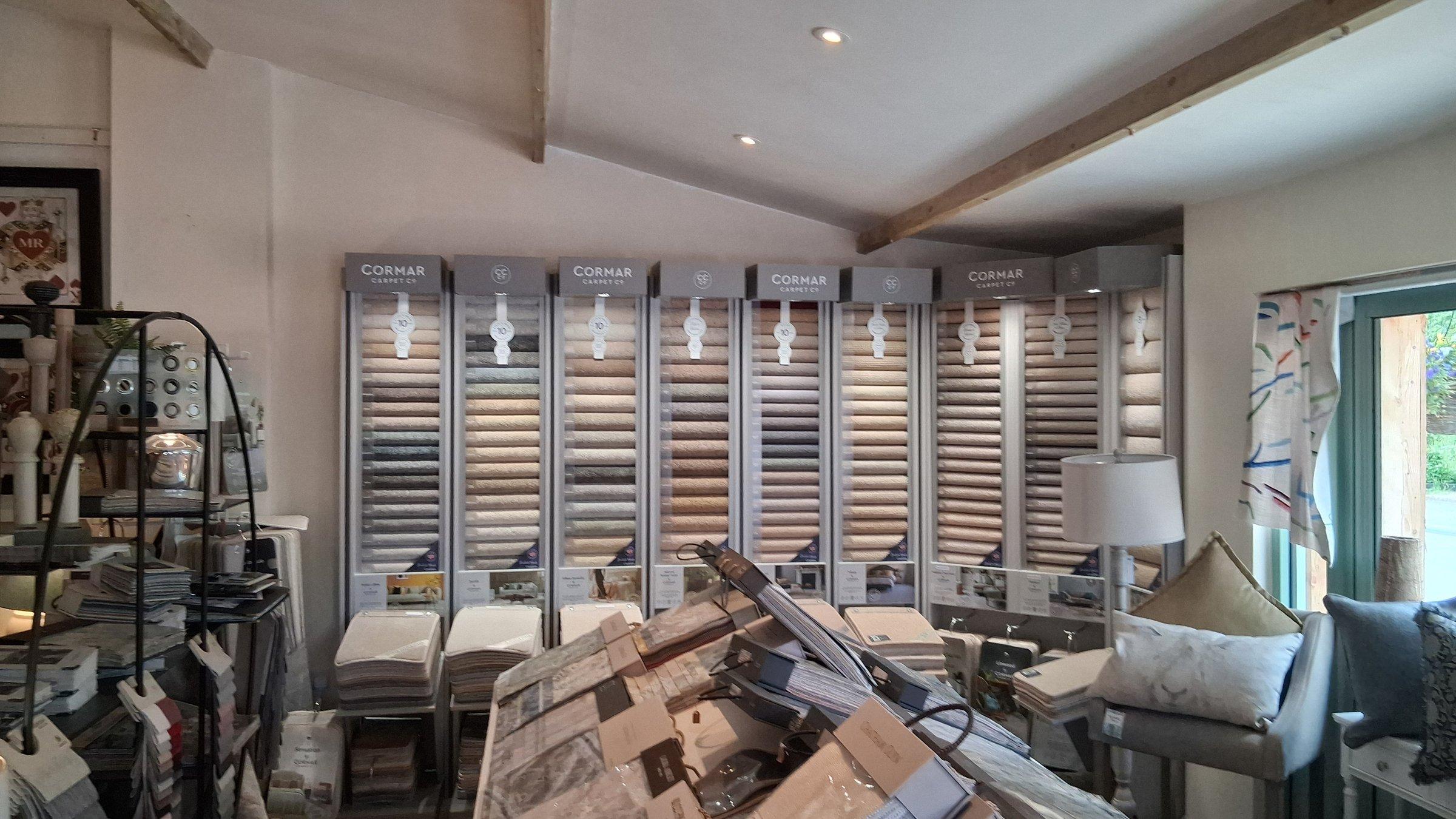
Choosing a carpet for a country home is harder than choosing one for a new-build, and most carpet retailers don't know it. Older houses come with sloping floors, mismatched levels between rooms, exposed stone or timber thresholds that the carpet has to die into honestly, dogs that come in muddy, and underfloor that often isn't level enough for the cheaper underlay.
The good news is most of these problems have settled answers if you ask the right questions before you order. This piece walks through what to think about, in roughly the order it matters.
Wool, wool blend, or synthetic
Pure wool feels best and ages best, but it isn't always the right answer. It's softer underfoot, holds colour for decades, and resists soiling better than people expect. The trade-off is price and, with high-traffic hallways or homes with dogs, the cost-per-year of a wool-rich blend can come out lower. Synthetics have come a long way, especially solution-dyed polypropylenes; for landings, kitchens, and holiday lets they're often the more practical call. The honest answer is room-by-room.
Pile height
The rule that holds up: short pile where feet are constant, longer pile where they aren't. Hallways, stairs, and landings want a low, dense twist that springs back rather than flattens. Sitting rooms and bedrooms can afford something deeper — a saxony reads as luxury underfoot, but it shows footprints and vacuum tracks, and some people love that while others find it maddening. Loop pile sits somewhere in between: hard-wearing and tidy-looking, but worth avoiding if you have cats, because claws catch in the loops. If in doubt, a mid-height twist is the carpet equivalent of a safe pair of hands. It suits nearly every room in a country house and forgives nearly everything.
Underlay
Underlay is where the budget conversation should start, not end, because it does more for how a carpet feels and lasts than most upgrades to the carpet itself. A good underlay takes the wear that would otherwise grind into the carpet backing, evens out small imperfections in the floor, and adds warmth and quiet — which matters in older houses with suspended timber floors and draughts that find their way through the boards. In a country home we'd usually steer towards a slightly thicker, denser underlay than the standard spec, especially upstairs and over uneven boards. Skimping here to afford a better carpet is the wrong way round: a mid-range carpet on excellent underlay will outperform an excellent carpet on cheap underlay, and feel better doing it.
Stairs
Stairs are the hardest-working carpet in the house and the most technical to get right. Pile direction matters: the pile should run down the stairs, so the tread wears on the pile's side rather than its tip — fitted the other way, it shades oddly and wears out years early. The shape of the nosing matters too. A rounded bullnose wants the carpet stretched tight around it; a square edge gives a crisper line but shows wear sooner. Then there's the runner question. A runner with painted or waxed timber either side looks right in a period cottage and is cheaper to replace when the middle wears, but it needs rods or proper fixing and the exposed edges need to be in decent condition. Full-width carpet is quieter, safer with young children, and more forgiving of scruffy treads. Either way, stairs are where the fitter's experience shows most — it's the first place we'd ask to see photographs before quoting.
Doorways and transitions
Every carpet in a country house eventually has to meet something else — kitchen tile, hall flagstones, bedroom oak — and these meetings are where cheap jobs announce themselves. The questions to settle before ordering: does the carpet meet the hard floor at the same level, or is there a step-down to manage? Is there an existing threshold bar you're keeping, or does the fitter supply one? Brass, dark bronze, and brushed steel bars all read very differently against flagstones. Where levels genuinely don't match — common where a concrete kitchen floor meets suspended boards — a good fitter will pack and ramp the underlay so your toe doesn't find the difference in the dark. Mention every transition when you book the measure; each one is ten minutes of fitting time and they add up.
Sloping floors
Almost every house more than a century old slopes somewhere, and the carpet has to follow the floor honestly. What an experienced fitter does differently: they check the subfloor before quoting rather than discovering it on the day, they'll tell you when a floor needs boarding or screeding first rather than carpeting over the problem, and they stretch the carpet to the room's actual shape rather than its theoretical one — older rooms are rarely square, and a carpet cut square in a room that isn't leaves a visible sliver against the skirting. None of this is exotic. It's just the difference between someone who fits older houses every week and someone who mostly does new-builds.
Dogs
The honest version: no carpet is dog-proof, but some fail much faster than others. Wool copes better with soiling than its reputation suggests — it releases dirt when dry and cleans up well — but claws and a determined digger will pull threads on loop pile, so cut pile is the safer construction. Solution-dyed synthetics are the practical choice for the rooms the dog actually lives in: the colour runs through the fibre rather than sitting on the surface, so cleaning products and repeated scrubbing don't fade them. Mid-tone heathered colours hide hair and the evidence of a wet morning far better than plain pale carpet. If the dog has the run of the house, consider hard-wearing synthetic in the hall and boot room and keep the wool for the rooms with the door shut.
The thirty-minute test
The most useful thing you can do before ordering costs nothing: sit in the showroom with three sample books for half an hour. Not five minutes — half an hour. Put the samples on the floor, not the table, because carpet is read from standing height in real light. Walk on them in socks. Fold them back and look at the density of the backing. Take the two finalists home and live with them for a week — against the skirting, next to the sofa, in morning light and lamplight. Colour swings dramatically between showroom lighting and a north-facing cottage sitting room, and an hour of patience here prevents years of mild regret.
For the full carpet service, see carpets, measured and fitted or book a free home measure.